
Built for Individual LTC Homes and Hospitals
Quebec Hospital Emergency Color Codes
Quebec Hospital Emergency Color Codes: CISSS & CIUSSS Standards
In Quebec, emergency color codes (codes d'urgence) provide standardized communication across hospitals, long-term care facilities (CHSLD), and health networks managed by CISSS (Centre intégré de santé et de services sociaux) and CIUSSS (Centre intégré universitaire de santé et de services sociaux). These standardized alert codes ensure immediate response and safety for healthcare staff, patients, and visitors.
This guide outlines the emergency code system used across Quebec healthcare establishments, primary response steps, and provincial health authority protocols.
Standard Quebec Emergency Color Codes (Codes d'urgence)
The following emergency codes are implemented across Quebec health network establishments to maintain provincial consistency during critical events:
| Color Code | Emergency Classification | Quebec Response Protocol |
|---|---|---|
| Code Rouge (Red) | Fire / Smoke (Incendie) | Follow REACT/RACE steps: Rescue individuals in immediate danger, Alarm/Activate pull station, Contain doors, Extinguish or Evacuate. |
| Code Bleu (Blue) | Adult Medical Emergency (Arrêt cardiorespiratoire) | Immediate response of the clinical resuscitation team for adult cardiac or respiratory arrest. |
| Code Rose (Pink) | Pediatric Medical Emergency (Urgence pédiatrique) | Specialized resuscitation team dispatch for infant or child cardiac/respiratory emergencies. |
| Code Blanc (White) | Violent / Aggressive Person (Personne violente) | Intervention by trained personnel and security to de-escalate verbal threats, physical aggression, or violent behavior. |
| Code Violet (Purple) | Hostage Situation (Prise d'otages / Personne barricadée) | Protocol for hostage incidents or barricaded hostile individuals. Security isolates the area and alerts local police. |
| Code Jaune (Yellow) | Missing Patient (Disparition d'un usager) | Initiates systematic internal and perimeter searches for a vulnerable or high-risk missing patient. |
| Code Ambre (Amber) | Child / Infant Abduction (Enlèvement d'enfant) | Immediate lockdown of facility exits, elevator controls, and monitoring points following a suspected abduction. |
| Code Brun (Brown) | Hazardous Spill (Déversement dangereux) | Containment protocol for internal chemical, biological, or hazardous material spills requiring specialized handling. |
| Code Noir (Black) | Bomb Threat (Alerte à la bombe) | Implementation of bomb threat checklists, search sweeps, and coordination with local law enforcement. |
| Code Argent (Silver) | Active Shooter / Armed Person (Tireur actif / Personne armée) | Response protocol for an active shooter or armed person: Run, Hide, Protect protocols and facility lockdown. |
| Code Vert (Green) | Evacuation (Évacuation) | Phased or immediate evacuation (precautionary or emergency) of a department, wing, or entire building. |
| Code Orange | External Disaster / Mass Casualty (Sinistre externe) | Activation of emergency management plans for community disasters or external events causing mass casualties. |
| Code Gris (Grey) | Infrastructure Failure (Panne d'infrastructure) | Protocol for critical loss of essential services (power, water, HVAC, IT networks) or toxic air intake shutdown. |
Key Features of Quebec Healthcare Emergency Standards
Emergency management across Quebec CISSS and CIUSSS networks incorporates several province-specific practices:
- Bilingual Communications: Emergency announcements in Quebec health settings are broadcast either bilingually or in French depending on regional status, using standardized code names recognized across English and French clinical teams.
- Integration Across CHSLDs: Long-term care facilities (CHSLDs) in Quebec utilize the exact same standardized emergency color codes as acute care hospitals, aiding staff who work across multiple health centers.
- Code Purple Provisions: Quebec maintains Code Violet (Purple) specifically for hostage or containment threats, keeping it distinct from general behavioral alerts (Code Blanc).
Explore Provincial Emergency Color Codes
Select another province below to review regional emergency code guidelines and healthcare standards:
- Canadian Emergency Color Codes Hub – Complete national summary and overview of Canadian hospital standards.
- Ontario Emergency Color Codes – Official Ontario Hospital Association (OHA) emergency standards.
- Alberta Emergency Color Codes – Alberta Health Services (AHS) provincial color code guide.
- British Columbia Emergency Color Codes – BC Health Authorities standardized color code guide.
- Atlantic Canada Emergency Color Codes – Codes for Nova Scotia, New Brunswick, PEI, and Newfoundland.
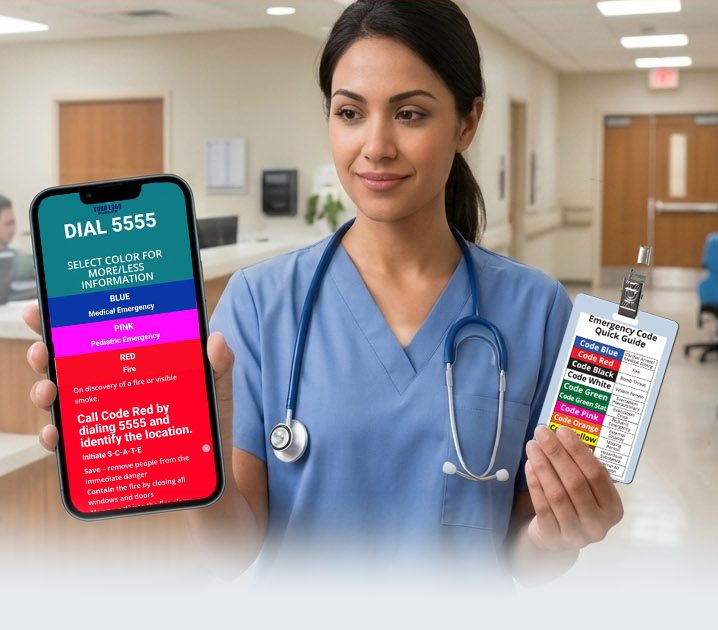
Master Healthcare Emergency Color Codes Reference Guide
What do the color codes mean?
Implementation in 3 Simple Steps

SITE MAPPING
Submit your code definitions, procedures and any other relevant information. We build and configure your custom PWA app for your approval. We also custom design your badge backers labels or entire info badges for your approval,
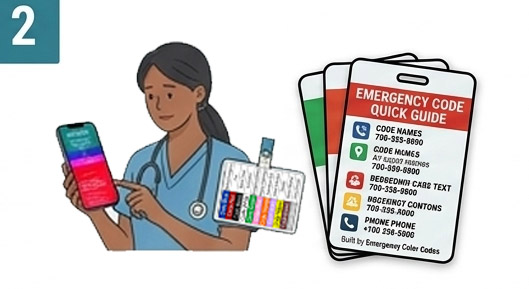
SOLUTION DELIVERY
After your approval, receive delivery of your custom badge backers and PWA app for your institution. Included is a implementation guide and designed station guides with QR code for installation.
STAFF DISTRIBUTION
Hand out badges and explain PWA app at shift huddles. Staff can easily scan the QR code to be instantly audit ready. PWA app can also be installed via link on your intranet or via email.
Easy Setup.
How Staff Access.
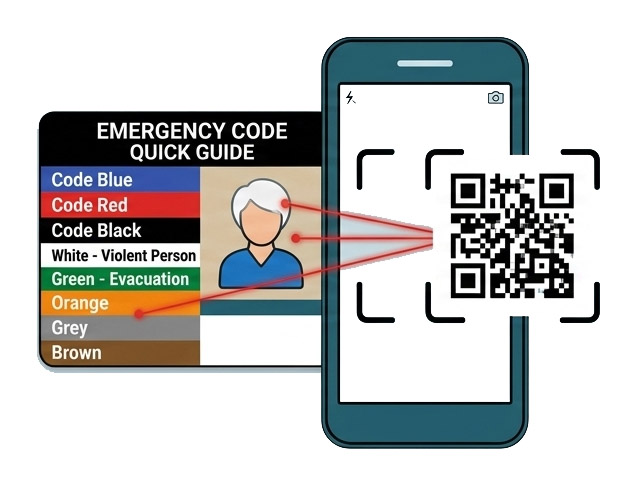
1. Scan
Scan provided QR codes or email links to easily access and install PWA app to device.
2. ACCESS
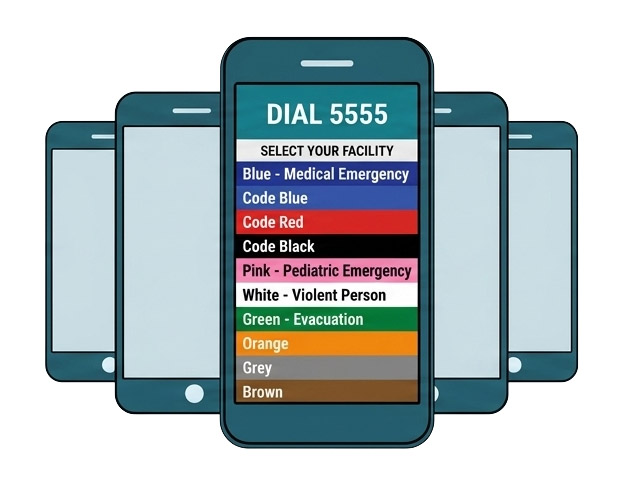
App opens instantly. Zero logins. Zero passwords
3. Offline
Works 100% offline.
Frequently Asked Questions
How are protocol changes handled after deployment?
Zero manual updates or re-installations are required from your team. When an administrator updates a code extension or protocol through our managed portal, changes are instantly deployed over the air. The next time staff devices connect to a network, the updated static assets sync automatically behind the scenes.
Is Mobile Device Management (MDM) or Intune required?
No. The solution is an offline-first Progressive Web App (PWA) that loads directly in any standard mobile browser via QR scan. It bypasses MDM provisioning entirely, requires zero app store downloads, requests zero device permissions, and works on both personal (BYOD) and facility-issued devices out of the box.
How do new hires and agency staff get oriented on day one?
Onboarding takes under 30 seconds. During shift huddles or orientation, new staff receive their physical badge backer and scan the QR code using their mobile camera. The app opens instantly without creating account profiles, signing up, or waiting for IT provisioning.
Does the PWA store any operational data or facility information on staff devices?
Only static, non-sensitive reference media (such as local code names and extension phone numbers) is cached locally via standard browser Service Workers. The application stores zero user inputs, zero logs, zero location history, and zero session data on the employee’s personal or facility device.
Do you use third-party tracking scripts, advertising pixels, or telemetry in the PWA?
No. To maintain strict zero-PHI compliance, the app contains zero third-party analytics (like Google Analytics or Meta Pixels), zero session-recording scripts, and zero advertising SDKs. The app communicates exclusively with our static content delivery network (CDN).
Get the Executive Evaluation & Pitch Kit
Everything you need to review the platform and pitch the solution to your leadership team—delivered to your inbox.
What’s Included:
- 📱 Live Interactive Sandbox Access
Scan or click to explore a fully pre-configured, offline-first PWA on your own device. - 🔒 CISO & IT Security Datasheet (PDF)
A 1-page technical breakdown proving Zero-PHI exposure, air-gapped architecture, and $0 IT overhead. - 📊 C-Suite Slide Deck
A 5-slide presentation built for CNOs, Risk Directors, and Procurement leads to justify adoption. - 📄 Procurement & Budget Justification Brief
Pre-written business case text and ROI framing to streamline departmental sign-off without RFP delays.